


Only switch under RF power when the manufacturer explicitly permits hot switching at the applied level. A continuous input rating does not prove switching capability.
How it works in practice
Mechanical contacts may briefly interrupt or change impedance as the dial moves. The resulting transient can reach a receiver or affect a power amplifier. Where a hot-switch specification is unavailable, mute or disconnect the source before changing the setting and restore the signal after the switch settles.
Example and interpretation
A component rated for 2 W continuous input may still require switching without RF present; these are separate requirements.
Checks before use
- Find the hot-switch specification
- Mute the source if unspecified
- Set the dial positively
- Restore power gradually
Important limit
Do not treat a continuous power rating as permission to switch live.
Related Centron RF product
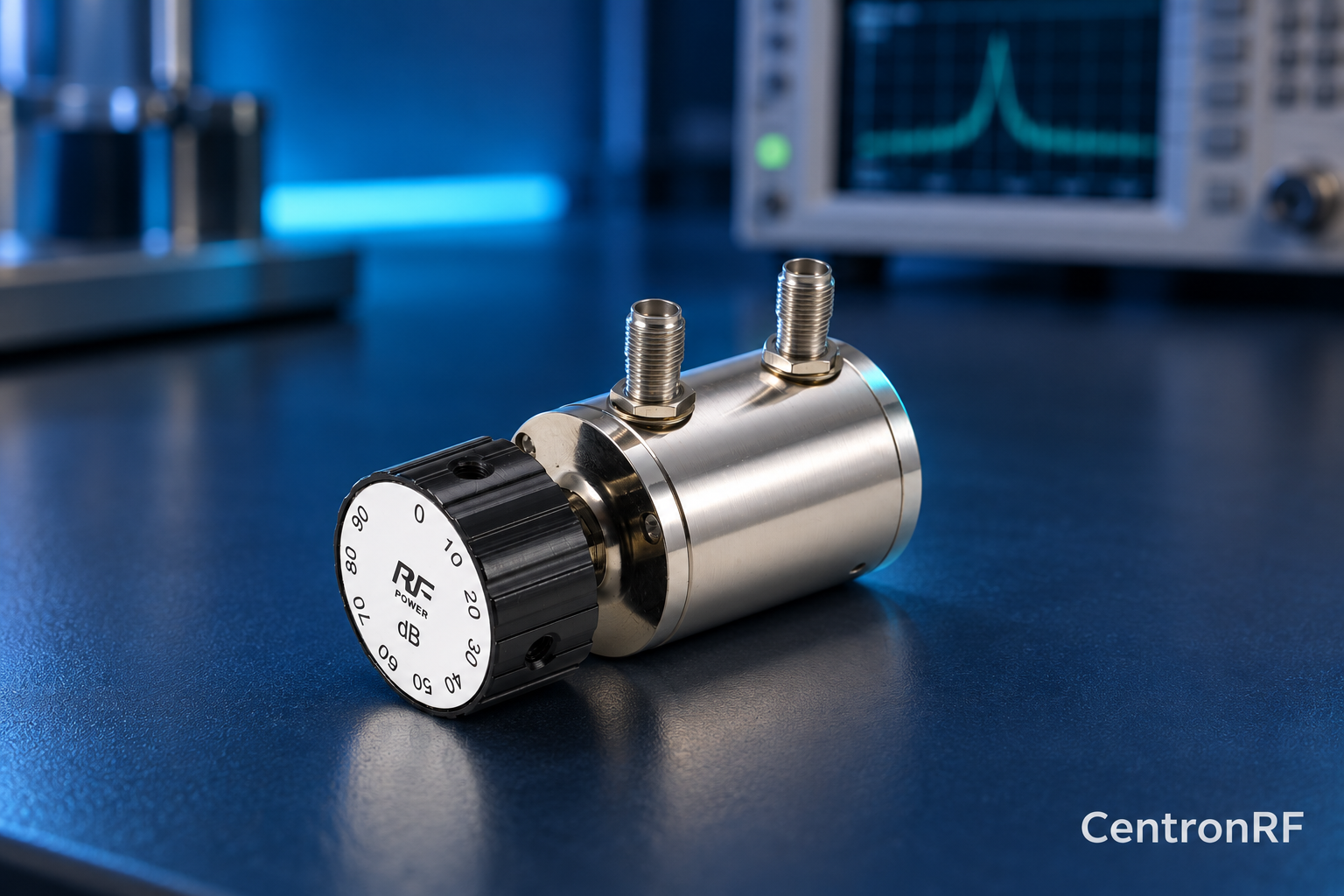
SMA rotary attenuator with 10 dB steps. The linked rotary model lists 0–90 dB adjustment in 10 dB steps, 50-ohm impedance and a DC–6 GHz band. Its listed continuous input is 2 W; obtain explicit switching and pulse limits before applying those stresses.
Further reading
Keysight: Accurate Network Measurements. This background reference explains general principles; the selected Centron RF model’s datasheet governs its own ratings.
Related guides
- Rotary Attenuator Repeatability: How to Check It
- Why High Attenuation Measurements Can Be Limited by Leakage
Educational guide. Numerical examples use the stated assumptions and are not test results for a supplied unit.