


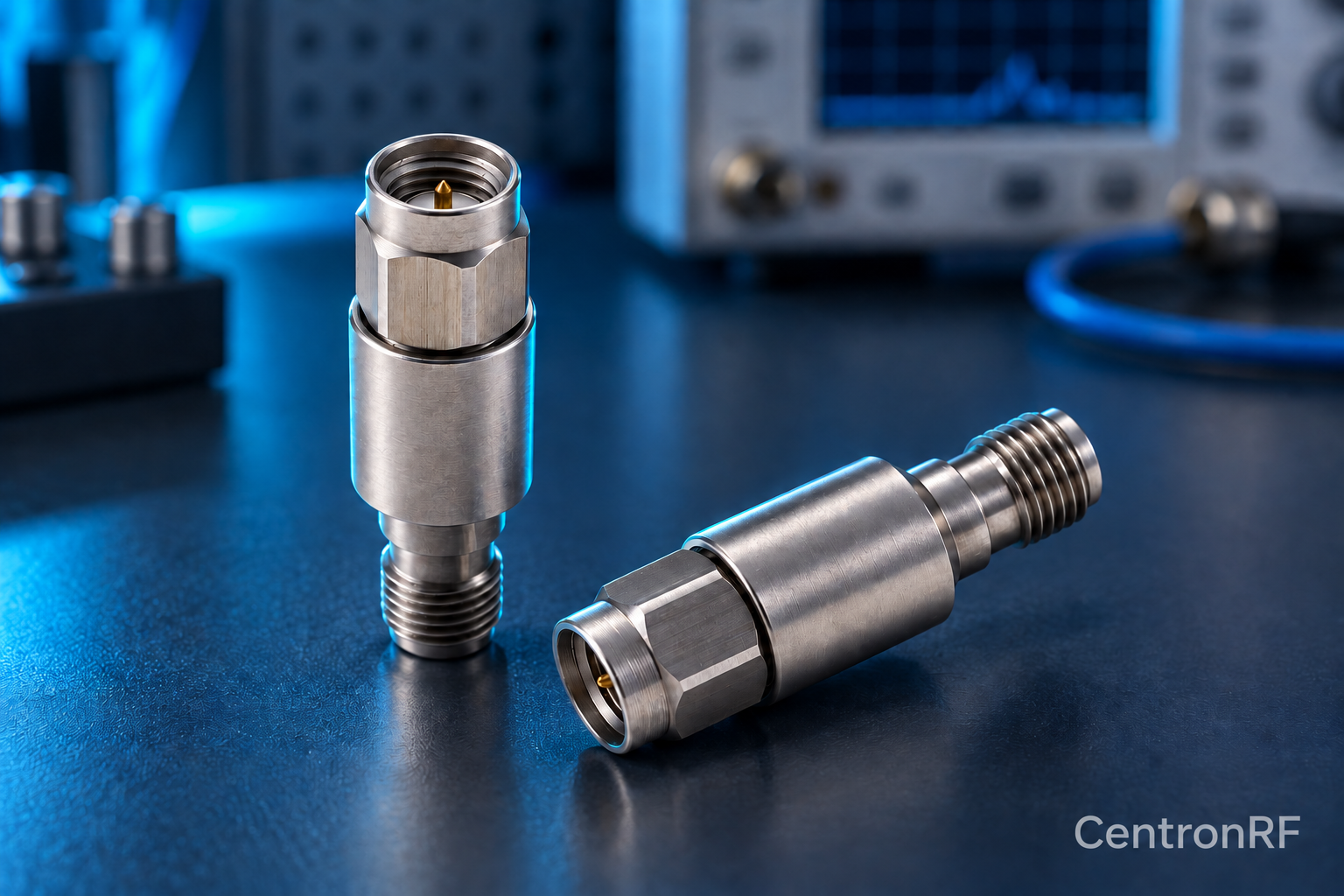
An SMA attenuator is appropriate for a compatible SMA signal path when its bandwidth and power ratings cover the application. SMA describes the connection, not the whole performance specification.
How it works in practice
Compact SMA components suit many instrument and laboratory connections. Mechanical fit alone is insufficient: confirm the nominal impedance, male or female interface, attenuation value and frequency-dependent performance. Support heavy cables so they do not bend the instrument connector or the attenuator's mating interface.
Example and interpretation
A 6 GHz SMA pad may suit a 2.4 GHz measurement, but that does not establish its attenuation accuracy or pulse capability without the corresponding specification.
Checks before use
- Check interface gender
- Confirm 50-ohm system compatibility
- Compare bandwidth and power
- Support cables and inspect the mating surfaces
Important limit
Do not infer an 18 GHz rating simply from an SMA connector.
Related Centron RF product
SMA 5 W 6 GHz fixed attenuator. The SMA 5 W model is listed as a 50-ohm fixed attenuator with a DC–6 GHz range. Select an available attenuation option and verify the current tolerance, cooling conditions and pulse limits for your application.
Further reading
Keysight: Spectrum Analysis Basics. This background reference explains general principles; the selected Centron RF model’s datasheet governs its own ratings.
Related guides
Educational guide. Numerical examples use the stated assumptions and are not test results for a supplied unit.