


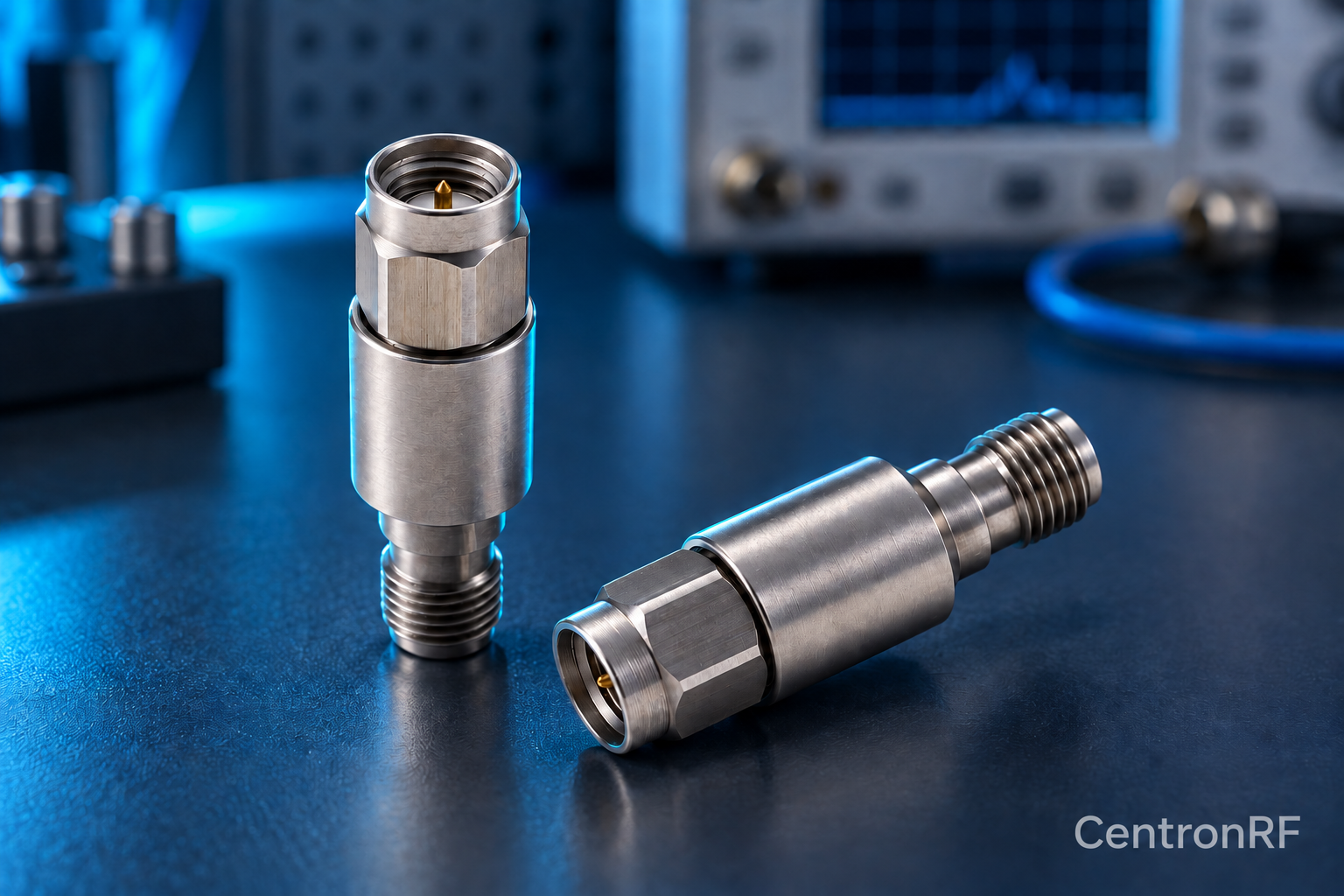
A fixed RF attenuator provides a predetermined reduction in signal power. It is useful when a measurement or signal path needs a stable, repeatable level reduction.
How it works in practice
The device has an input and output, unlike a one-port dummy load. Resistive attenuation converts part of the incoming RF energy into heat while passing the remaining signal onward. Its fixed value simplifies a permanent test setup, but the actual loss still depends on frequency, manufacturing tolerance and temperature.
Example and interpretation
A nominal 10 dB pad transmits one tenth of the incident power in an ideal matched system. The remaining nine tenths become heat.
Checks before use
- Identify the receiving device's level range
- Select the nominal loss
- Confirm the pad's thermal rating
- Measure actual loss at the operating frequency
Important limit
A fixed attenuator is not automatically a DC block or surge protector.
Related Centron RF product
SMA 5 W 6 GHz fixed attenuator. The SMA 5 W model is listed as a 50-ohm fixed attenuator with a DC–6 GHz range. Select an available attenuation option and verify the current tolerance, cooling conditions and pulse limits for your application.
Further reading
Keysight: Spectrum Analysis Basics. This background reference explains general principles; the selected Centron RF model’s datasheet governs its own ratings.
Related guides
Educational guide. Numerical examples use the stated assumptions and are not test results for a supplied unit.